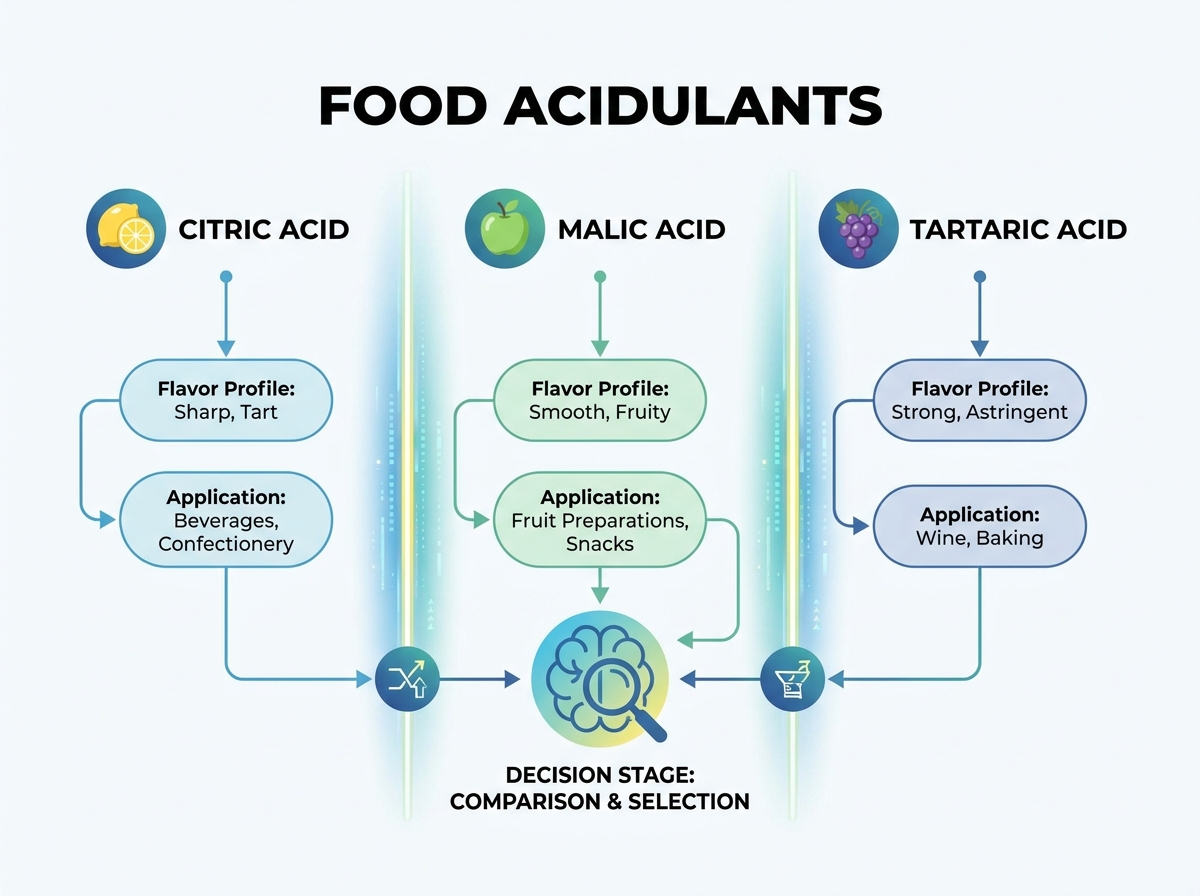
Formulating food and beverage products for exact sensory profiles and shelf stability requires precise control over pH and tartness, making acidulant selection a critical R&D decision. Misjudging an acid's flavor onset, intensity peak, or duration can disrupt organoleptic balance, fail to mask off-notes from alternative sweeteners, or unnecessarily inflate formulation costs. This guide provides a technical evaluation of the three primary Food Acidulants—citric, malic, and tartaric acid—comparing their sensory profiles, functional properties, and cost-in-use to guide formulation and procurement strategies.
Citric Acid delivers a sharp, immediate burst of tartness that dissipates quickly, making it the industry standard for citrus profiles and broad-spectrum pH control.
Malic Acid provides a smoother, lingering sourness that enhances fruit flavors and effectively masks the aftertaste of high-intensity sweeteners, often requiring a lower dosage than citric acid.
Tartaric Acid offers a highly specific, dry, and astringent profile ideal for grape-flavored applications and wine adjustments, though its higher cost limits general use.
Strategic Blending of these acids allows formulators to customize the flavor release curve, balancing immediate impact with prolonged taste while optimizing raw material costs.
The Strategic Role of Food Acidulants in Product Formulation
A successful acidulant application achieves much more than basic sourness. Formulators rely on these ingredients to manipulate the entire sensory experience while ensuring physical and chemical stability across the product's lifespan. When you add an acid to a beverage or food matrix, you are fundamentally altering its thermodynamic environment. This shift dictates how proteins behave, how emulsions hold together, and how long the product can sit on a shelf before microbial degradation occurs.
Lowering pH is a primary requirement to inhibit bacterial growth and extend shelf life. This is especially critical in beverages, sauces, and acidified foods where microbial stability dictates safety and viability. Pathogens like Clostridium botulinum cannot produce toxins in environments with a pH below 4.6. By strategically deploying specific acids, food scientists create a hurdle effect that prevents spoilage organisms from multiplying. Beyond preservation, acidulants amplify specific top-notes. They determine whether a beverage tastes like a bright lemon or a ripe berry. They also act as essential masking agents for the metallic or bitter off-notes inherent in stevia, sucralose, or plant-based proteins.
Secondary functions include chelating properties. Acidulants bind transition metal ions, such as iron and copper, preventing oxidation, rancidity, and color degradation in sensitive matrices. When trace metals catalyze lipid oxidation, the resulting off-flavors can ruin a product's market viability. Furthermore, acids directly impact protein denaturation and emulsion integrity in fat-containing systems like curds, custards, and dressings. If you drop the pH too quickly in a dairy emulsion, the casein proteins will reach their isoelectric point and precipitate out, causing a grainy texture.
Establish the target pH required for microbial safety based on the product's moisture content and storage conditions.
Identify the primary characterizing flavor to select an acid with a complementary sensory onset and duration.
Evaluate the matrix for potential reactive components, such as dairy proteins or hydrocolloids, that may destabilize under acidic conditions.
Determine the buffering capacity of the system to ensure the pH remains stable throughout the intended shelf life.
Citric Acid: The Baseline Standard for Food Acidulants
Citric acid features a fast onset with a sharp, aggressive peak that dissipates rapidly. This quick flavor drop-off clears the palate, making it highly effective for refreshing applications. When a consumer takes a sip of a lemon-lime soda, the immediate bite they experience is almost entirely driven by citric acid. It hits the taste receptors instantly and leaves just as fast, preventing flavor fatigue and encouraging the consumer to take another sip.
Ideal use cases include clear sodas, lemon, lime, and orange-flavored beverages, general confectionery, and canned goods. Its high solubility and universal recognition make it a staple in most formulation labs. You will find it in almost every dry beverage mix because it dissolves rapidly in cold water without clumping, provided the manufacturing environment maintains strict humidity controls.
While highly soluble and universally recognized, the rapid flavor drop-off lacks the carry-through needed for complex, multi-layered flavor profiles. It can also be perceived as harsh or biting in high doses. If you try to use citric acid to support a heavy, dark fruit flavor like blackberry or plum, the sensory mismatch becomes obvious. The acid spike finishes long before the heavy fruit notes resolve, leaving a disjointed flavor experience.
Property
Citric Acid Anhydrous
Citric Acid Monohydrate
Moisture Content
Less than 0.5%
Approximately 8.6%
Solubility (at 20°C)
163 g / 100 ml water
147 g / 100 ml water
Hygroscopicity
High (requires strict humidity control)
Moderate (more stable in dry mixes)
Primary Application
Liquid beverages, syrups, sauces
Dry powdered mixes, effervescent tablets
Malic Acid: The Lingering Flavor Enhancer
Malic acid presents a delayed onset with a smooth peak and a prolonged, lingering tartness. This profile closely mimics natural fruit ripening, providing a more rounded sensory experience compared to the sharp hit of citric acid. When you bite into a crisp apple, the tartness you experience builds slowly and stays on your tongue. This is the exact sensory curve malic acid provides in a formulated product.
Formulators use malic acid extensively in stone fruit profiles like peach and cherry, as well as berry applications. It is also a primary driver in extreme sour candies and sugar-free formulations where masking is required. Because the sourness lingers, it covers the delayed bitter spikes often associated with high-intensity sweeteners. If you are working with a stevia-sweetened beverage, swapping a portion of your citric acid for malic acid will significantly improve the finish.
A critical procurement advantage lies in its efficiency. Malic acid often yields a higher perceived sourness than citric acid. This allows formulators to use less total volume—often a 10 to 15% reduction—to achieve the exact same sensory outcome, optimizing overall formulation efficiency. You have to evaluate the cost based on the required dosage to hit the target sensory intensity, not just the raw material price.
Tartaric Acid: The Specialized Astringent
Tartaric acid delivers a hard, dry, and slightly astringent tartness that creates a highly distinct mouthfeel. Its sensory curve is intense but highly specific. It pulls moisture from the palate, creating a puckering sensation that is entirely different from the clean bite of citric or the smooth linger of malic.
Niche uses dominate its application spectrum. It is essential for grape and tamarind flavor profiles, wine acidification, and functions as a chemical leavening agent (cream of tartar) in baked goods. In winemaking, tartaric acid is the primary tool for adjusting the titratable acidity of the must before fermentation, ensuring the final wine has the correct structural backbone and microbial stability.
Limitations include a highly specific flavor profile that restricts its viability as a primary, broad-spectrum acidulant. Global supply chain stability can also fluctuate, making it less reliable for high-volume products. Because it is often derived as a byproduct of the wine industry, poor grape harvests can directly impact availability and raw material costs.
Head-to-Head Technical Evaluation: Choosing the Right Acid
Sensory Curves and Flavor Matching
Matching the acid to the characterizing flavor is the foundation of sensory design. Citric acid provides the sharp punch needed for citrus. Malic acid supports fleshy, late-summer fruits. Tartaric acid aligns perfectly with vine fruits. You must map the time-intensity curve of your flavor system and select an acid that mirrors that curve. If your flavor peaks at 3 seconds and fades at 6 seconds, your acidulant should do the same.
Chemical Specifications: pKa Values and Buffering Capacity
The dissociation constants (pKa) of each acid guide pH targets. Citric acid has a pKa1 of 3.13, malic acid sits at 3.40, and tartaric acid is the strongest with a pKa1 of 2.98. These thermodynamic properties dictate the buffering capacity required to stabilize formulations against pH drift over time. When formulating a beverage with a target pH of 3.2, citric acid will provide excellent buffering capacity because the target pH is very close to its pKa1 value. This means the system will resist changes in pH even if trace alkaline components are introduced during manufacturing.
Solubility, Hygroscopicity, and Manufacturing Realities
Behavior in dry mixes versus liquid solutions varies significantly. Hygroscopicity risks dictate manufacturing parameters in powdered beverages and hard candies. Citric acid has a higher tendency to absorb moisture, causing caking and stickiness, whereas malic acid remains more stable in dry environments. If you are running a high-speed packaging line for a powdered drink mix, excessive humidity will turn a citric acid-based formula into concrete inside the hoppers. Switching to malic acid or a coated acidulant can resolve these flowability issues.
Cost-in-Use vs. Price Per Kilogram
Raw material cost must be weighed against dosage efficiency. A cheaper price per kilogram for citric acid does not always equate to the lowest formulation cost if a higher dosage is required to match the perceived sourness of malic acid. You must calculate the exact grams per liter required to hit your sensory target and multiply that by the raw material cost to find the true cost-in-use.
Acidulant
Sensory Onset
Duration
Primary Application
Hygroscopicity
Citric Acid
Fast, Sharp
Short
Citrus, Clear Sodas
High
Malic Acid
Delayed, Smooth
Lingering
Stone Fruits, Berries
Low
Tartaric Acid
Hard, Dry
Moderate
Grape, Wine, Baking
Moderate
Expanding the Spectrum: Secondary and Alternative Acidulants
Lactic acid serves as a milder, dairy-compatible option. It rounds out sharpness, softens fruit profiles, and preserves shelf life in savory applications, dressings, and dairy-based fillings without breaking emulsions. Because it is naturally found in fermented dairy products, it integrates seamlessly into cheese sauces and yogurt-based dressings without causing the harsh, artificial bite that citric acid would introduce.
Fumaric acid features extremely low solubility but unmatched cost-efficiency and low hygroscopicity. This makes it ideal for dry powdered mixes, tortillas, and rye breads where moisture control is paramount. In tortilla manufacturing, fumaric acid lowers the pH to improve the effectiveness of antimycotic preservatives like calcium propionate, extending the mold-free shelf life without dissolving too quickly and interfering with the dough rheology.
Phosphoric acid stands apart as an inorganic option. It dominates cola formulations, providing an intense, sharp pH-lowering capacity at a minimal cost-in-use. It provides a flat, purely sour sensation without any fruity notes, which is exactly what a complex, spice-heavy cola profile requires to maintain its dark, heavy sensory characteristics.
Strategic Blending: Optimizing Food Acidulants for Complex Profiles
Relying on a single acid often results in a flat or unbalanced flavor profile. Blending allows formulators to manipulate the time-intensity curve for a superior consumer experience. By combining acids with different onset times and durations, you can create a continuous perception of tartness that lasts from the initial sip through the swallow.
Rounding the flavor curve involves blending citric acid for the initial punch with malic acid for the lingering finish. This creates a full-bodied, natural-tasting tartness that single acids cannot achieve. When you analyze the acid profile of natural fruit juices, you rarely find just one acid. An orange contains mostly citric acid, but also trace amounts of malic. Replicating these natural ratios in your formulation yields a much more authentic flavor.
Common industry-standard conceptual ratios include a 60:40 citric to malic blend for hard candies, or an 80:20 citric to tartaric blend for complex berry profiles. These ratios balance sensory impact with raw material efficiency. In a gummy application, a 70:30 blend of malic to citric provides enough initial bite to register as sour, while the malic acid carries the tartness through the extended chew time of the gelatin matrix.
Implementation Risks and Formulation Trade-Offs
Acidulants can cause sucrose inversion in hard candies, leading to weeping, stickiness, and shortened shelf life. Mitigate this risk through precise temperature control, the addition of buffering salts, and careful acid selection. When sucrose breaks down into glucose and fructose under high heat and low pH, the resulting invert sugar is highly hygroscopic. It will pull moisture from the air, turning a hard candy into a sticky mess. Adding the acid at the very end of the cooling process minimizes the time the sucrose is exposed to the acidic environment at high temperatures.
Hydrocolloid interactions present another challenge. Rapid pH drops impact the setting properties of pectin, gelatin, and carrageenan in gummies, jellies, and jams, requiring controlled acid dosing at specific temperature thresholds. High-methoxyl pectin requires a pH between 2.8 and 3.2 to form a gel network. If the acid is added too early, the pectin will pre-gel in the holding tank, ruining the batch.
Incorrect acid selection can destabilize fat emulsions and coagulate egg or dairy proteins. In products like lemon curds, custards, and sauces, rapid acid addition causes textural breakdown and syneresis. You must use high-shear mixing and potentially incorporate protective hydrocolloids or emulsifiers to stabilize the protein matrix before introducing the acidulant.
Regulatory and labeling compliance must also be monitored. While these acids hold GRAS (Generally Recognized as Safe) status, consumer perception often favors naturally derived sources over synthetically produced variants on ingredient declarations. Ensure your procurement team verifies the source material and manufacturing process if your product carries specific clean-label claims.
Conclusion
Conduct bench-top sensory panels with time-intensity mapping to evaluate acid blends against your target flavor profile.
Perform accelerated shelf-life testing to monitor pH drift, moisture migration, and sucrose inversion over time.
Calculate true cost-in-use by factoring in dosage reductions when substituting malic for citric acid in your master formula.
Test hydrocolloid and emulsion stability under varying acidulant concentrations before moving to commercial scale-up.
FAQ
Q: Can I substitute malic acid for citric acid in a 1:1 ratio?
A: A direct 1:1 substitution alters the flavor profile significantly. Malic acid provides a lingering tartness and higher perceived sourness. Formulators usually require a 10-15% reduction in malic acid dosage to match the intensity of citric acid.
Q: Which food acidulant is best for sour gummies?
A: Malic acid is highly effective for sour gummies due to its lingering sourness and lower hygroscopicity, which prevents sweating. It is often blended with citric acid to provide an initial sharp punch followed by a prolonged tart finish.
Q: How do food acidulants affect high-intensity sweeteners?
A: The lingering sensory profile of malic acid effectively masks the delayed bitterness and metallic off-notes of sweeteners like stevia and sucralose. Citric acid's rapid drop-off leaves these off-notes exposed on the palate.
Q: Is lactic acid used similarly to citric, malic, and tartaric acids?
A: Lactic acid is a milder, dairy-compatible acidulant. Unlike the sharp fruit profiles of citric or malic, lactic acid is used primarily for savory, fermented, or creamy profiles, such as dressings and cheese sauces.
Q: What is the most cost-effective food acidulant?
A: While citric acid generally has the lowest raw commodity price per kilogram, true cost-in-use varies. Malic or fumaric acid can sometimes be more economical because their higher perceived intensity allows for lower required dosages.
Q: How does the choice of acidulant impact product shelf life?
A: Acid choice directly impacts pH buffering and microbial stability. Additionally, highly hygroscopic acids like citric can cause moisture migration in dry goods, leading to caking and reduced shelf life compared to more stable options like malic or fumaric acid.
Nanjing MSN Chemical Co., Ltd. is a professional chemical company specializing in the global distribution of high-quality chemical products. With 20 years of industry expertise, we are committed to providing innovative solutions and reliable services to meet the diverse needs of our clients worldwide.