1. Introduction
Have you ever wondered how materials can change their properties with temperature? At the molecular level, polymers like N-Vinylcaprolactam (NVCL) hold the key to this transformation.
In this article, we’ll explore how NVCL’s tunable LCST (Lower Critical Solution Temperature) is revolutionizing biomedical materials. You’ll discover how adjusting this temperature opens up new possibilities in drug delivery, tissue engineering, and more.
2. The Molecular Mechanism of NVCL and its Tunable LCST
NVCL’s Molecular Structure and Properties
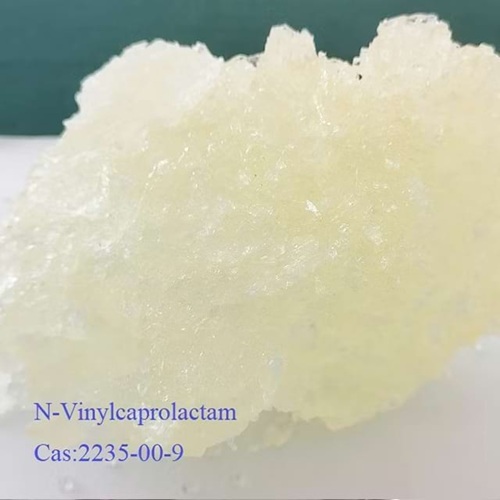
N-Vinylcaprolactam (NVCL) is a thermoresponsive polymer known for its unique molecular structure. It is composed of a vinyl group and a caprolactam ring, which gives it both hydrophilic and amphiphilic properties. This structure is crucial for its ability to undergo phase transitions in response to temperature changes. At lower temperatures, NVCL remains in a hydrated, solvated state, while at higher temperatures, it experiences a transition where it loses its hydration, resulting in the polymer shrinking. This property is the foundation of its Lower Critical Solution Temperature (LCST), typically around 33°C.
The versatility of NVCL’s structure allows it to interact with various solvents and other polymer systems, making it an attractive candidate for biomedical materials. The molecular flexibility of NVCL, combined with its high water absorption capacity, ensures that it can perform well in environments where precise control of water content and swelling is required, such as in drug delivery and tissue engineering applications.
The Principle and Tunability of LCST
LCST refers to the specific temperature at which a polymer in solution undergoes a dramatic change from a hydrated (swollen) state to a dehydrated (shrunk) state. For NVCL-based polymers, the LCST typically occurs at 33°C. However, one of the most remarkable features of NVCL is the ability to modify this LCST range by incorporating different monomers into its polymerization process.
Through copolymerization with other monomers such as N-vinylpyrrolidone or N-vinylacetamide, researchers can shift the LCST of NVCL-based materials anywhere from 33°C to as high as 80°C. This tunability enables the creation of more customizable materials for specific applications, especially in fields like biomedical engineering where control over temperature sensitivity is crucial for optimal performance.
Mechanisms for Adjusting LCST
There are several methods to adjust the LCST of NVCL-based materials, primarily involving copolymerization with other functional monomers. By carefully selecting the co-monomer, it is possible to tune the thermal response to meet the specific needs of a given application. For example, the inclusion of N-vinylpyrrolidone lowers the LCST, making the material responsive at lower temperatures, while adding vinyl esters can raise the LCST to higher temperatures.
This ability to adjust the LCST allows for more precise control in biomedical applications, such as ensuring that drug delivery systems or tissue scaffolds only react when they reach a particular temperature, providing greater control over their function and interaction with biological tissues.
3. Biocompatibility and Thermoresponsive Characteristics of NVCL
Advantages of NVCL in Biomedical Applications
NVCL has proven to be an excellent candidate for biomedical applications due to its biocompatibility, non-toxicity, and ability to perform effectively in aqueous environments. Unlike many other thermoresponsive polymers that may degrade or release harmful by-products, NVCL is non-toxic when degraded, making it safer for use in medical applications such as wound dressings, injectable hydrogels, and tissue scaffolds.
Additionally, NVCL’s solubility in water and organic solvents increases its versatility for a range of applications, from drug delivery systems to cell encapsulation. These properties are key factors that have led to its increasing popularity in the development of advanced biomedical materials.
Thermoresponsive Behavior
NVCL’s thermoresponsive behavior is primarily dictated by its LCST. This means that when the temperature reaches the LCST, the polymer undergoes a phase transition, shifting from a swollen, hydrated state to a collapsed, dehydrated state. This reversible behavior makes NVCL an ideal candidate for applications where the material needs to respond to temperature changes, such as in drug delivery systems that release therapeutics at specific temperatures or in tissue engineering where a scaffold must change its properties in response to body temperature.
The ability to finely tune the LCST of NVCL-based materials adds an additional layer of functionality, allowing for the precise control of when and how materials interact with biological systems.
Application of Temperature-Controlled Biomaterials
Temperature-responsive biomaterials, such as those based on NVCL, can be programmed to react at specific physiological temperatures. This capability is particularly valuable for controlled drug delivery systems. For instance, a drug-loaded NVCL-based hydrogel can remain stable at room temperature but release its contents when it reaches body temperature (around 37°C). This controlled release minimizes side effects and maximizes therapeutic efficacy.
In tissue engineering, NVCL hydrogels can serve as scaffolds that change their mechanical properties in response to temperature, enabling the material to better mimic the behavior of natural tissues. These characteristics are especially useful in regenerative medicine, where scaffolds need to support cell growth and differentiation before biodegrading in the body.
4. Applications of NVCL’s Tunable LCST in Biomedical Materials
Drug Delivery Systems
One of the most promising applications of NVCL’s tunable LCST is in drug delivery. By incorporating NVCL into hydrogels or nanogels, researchers can design temperature-sensitive carriers that release their payload only when exposed to specific temperatures. This enables "on-demand" drug release, which is particularly useful in targeting localized treatments or controlling drug release over extended periods.
For instance, PNVCL-based hydrogels have been studied extensively for their ability to carry and release a variety of therapeutic agents, from small molecules to macromolecules. The temperature sensitivity of these hydrogels ensures that the drug is only released when it reaches the desired site or when triggered by a physiological temperature.
Tissue Engineering
NVCL-based hydrogels have shown significant potential in tissue engineering, especially in applications requiring the precise control of hydration, mechanical properties, and cell interactions. These hydrogels can be used to create scaffolds that mimic the extracellular matrix, providing a supportive environment for cell growth and tissue regeneration.
The tunable LCST of NVCL allows these scaffolds to respond to changes in temperature, which is crucial for applications in which the material must be injectable or responsive to body temperature. This feature has led to NVCL-based hydrogels being studied for cartilage repair, wound healing, and even bone regeneration.
Antimicrobial and Diagnostic Applications
NVCL-based materials also show promise in antimicrobial and diagnostic applications. The biocompatibility and temperature-responsiveness of these materials allow them to be used as antimicrobial coatings or in bioimaging systems. For example, NVCL hydrogels can be incorporated with silver nanoparticles to create materials that exhibit both thermoresponsive and antimicrobial properties, offering a dual functionality for medical devices or wound dressings.
Additionally, the ability to tune the LCST of NVCL allows for the development of diagnostic materials that change their properties in response to temperature shifts, making them ideal for use in temperature-sensitive diagnostic tools.
Nanocomposite Hydrogels
Incorporating nanoparticles into NVCL-based hydrogels can significantly improve their mechanical strength, thermal responsiveness, and overall performance. For example, the inclusion of graphene or nanocellulose in NVCL hydrogels has been shown to enhance their swelling capacity and thermal stability. These nanocomposite hydrogels are not only more robust but also provide additional functionalities, such as improved electrical conductivity or enhanced drug-loading capacity.
Below is a comparison table showing the impact of different nanomaterials on NVCL hydrogel properties:
Nanomaterial | Effect on NVCL Hydrogel | Application |
Graphene | Increases swelling ratio and mechanical strength | Drug delivery, wound care, tissue scaffolds |
Nanocellulose | Enhances mechanical stiffness and water retention | Drug release, tissue engineering |
Silver Nanoparticles | Provides antimicrobial properties and improved stability | Antimicrobial dressings, wound care |
Titanium Dioxide (TiO2) | Improves mechanical properties and UV resistance | Bioimaging, antimicrobial applications |
Clay Nanoparticles | Enhances thermal stability and mechanical behavior at high temperatures | Tissue scaffolding, drug delivery |
5. Composite Applications of NVCL with Other Materials
NVCL and Metal/Non-metal Nanoparticle Composites
One of the key advancements in NVCL-based materials is the development of composites that combine NVCL with metal or non-metal nanoparticles. These composites enhance the mechanical properties of the hydrogels, making them more robust for use in demanding applications. For example, the incorporation of gold or silver nanoparticles into NVCL-based hydrogels imparts antibacterial properties, which is highly beneficial in wound care and infection control.
The Impact of Nanomaterials on NVCL Hydrogel Performance
Nanomaterials such as graphene, silica, and titanium dioxide can be used to modify the performance of NVCL-based hydrogels. These materials not only improve the mechanical properties but also enhance the thermal stability and responsiveness of the hydrogel. This leads to hydrogels that can withstand more extreme conditions and perform more efficiently in medical applications.
The addition of nanomaterials allows for better control over the swelling properties of the hydrogels, which is particularly useful in drug delivery applications where controlled release is critical.
Development of Vectorized Materials
The development of vectorized materials is another important advancement in NVCL technology. By combining NVCL with other thermoresponsive polymers, it is possible to create complex materials that can be fine-tuned for specific applications. These materials may be used in applications ranging from targeted drug delivery to tissue engineering, where both the mechanical properties and temperature-responsiveness of the material are critical for success.
6. Challenges and Future Trends in NVCL’s Tunable LCST Technology
Limitations of Current Technologies
While NVCL-based materials have shown significant promise, there are still challenges in controlling and stabilizing the LCST adjustments in practical applications. The precision with which the LCST can be tuned is limited by the chemical nature of the monomers used in copolymerization, and achieving a consistent LCST across large-scale production remains a hurdle.
Clinical Challenges
Despite the advancements in NVCL-based hydrogels, clinical application remains limited. There are currently no FDA-approved NVCL-based products, and more research is needed to prove their efficacy and safety in human applications. Additionally, regulatory hurdles and the need for standardized manufacturing processes pose significant challenges for the widespread adoption of NVCL-based biomaterials.
Future Prospects
The future of NVCL-based materials is promising, especially in personalized medicine and smart drug delivery systems. As research progresses, we can expect to see more efficient methods for controlling LCST and new applications in areas such as bioimaging, tissue engineering, and regenerative medicine. With ongoing advancements in nanotechnology and polymer chemistry, NVCL-based materials are likely to play a pivotal role in the future of biomedical engineering.
7. Conclusion
NVCL’s tunable LCST is transforming biomedical materials by enabling precise control over their properties. This capability unlocks new possibilities in drug delivery, tissue engineering, and antimicrobial applications. As NVCL-based materials evolve, they hold great potential for advancing personalized medicine and smart medical solutions. Nanjing MSN Chemical Co., Ltd. is leading this innovation with its products, providing value through advanced thermoresponsive materials tailored to meet diverse biomedical needs.
FAQ
Q: What is N-Vinylcaprolactam (NVCL)?
A: N-Vinylcaprolactam (NVCL) is a thermoresponsive polymer known for its ability to undergo a phase transition at a specific temperature, making it ideal for biomedical applications.
Q: How does NVCL's tunable LCST work?
A: NVCL’s LCST (Lower Critical Solution Temperature) can be adjusted by incorporating different monomers, enabling precise control over its thermal responsiveness in biomedical materials.
Q: What are the advantages of NVCL in biomedical materials?
A: NVCL offers biocompatibility, non-toxicity, and precise thermal responsiveness, making it suitable for applications like drug delivery, tissue engineering, and diagnostics.
Q: Why is the tunability of LCST important for NVCL-based materials?
A: The tunability of LCST allows NVCL-based materials to respond to specific temperatures, enhancing their effectiveness in controlled drug release and other biomedical applications.
Q: How can NVCL be used in drug delivery systems?
A: NVCL-based materials, with their tunable LCST, allow for temperature-triggered drug release, ensuring controlled and efficient delivery of therapeutic agents.
Q: What makes NVCL suitable for tissue engineering?
A: NVCL's biocompatibility and temperature sensitivity make it an ideal material for creating scaffolds that support cell growth and tissue regeneration in various biomedical applications.


